
Gravity
Jul 28, 2026
By Raksha Shanmugavelayutham
Our Milky Way galaxy is a massive spiral containing billions of stars, numerous planetary systems, vast nebulae, and other celestial objects — all while moving nearly 600 kilometers per second through space. Despite our galaxy's immense size and constant motion, its structure is neatly preserved by something considered the weakest force of nature: gravity.
Many people assume that gravity is just a force that causes an apple to fall from a tree. In truth, it is one of the four fundamental forces of nature that governs our universe. Unfortunately, we still do not fully understand gravity, despite early theories from great scientists such as Isaac Newton.
Newton's Universal Theory of Gravitation
Published in the late 1600s, Newton's Universal Theory of Gravitation was one of the first widely accepted explanations of gravity. His theory defines gravity as the attraction between two objects, stating that every particle attracts every other particle. His law explains that particles are attracted to each other with a force proportional to the product of their masses and inversely proportional to the distance between them squared. This relationship is expressed by the equation:
In this formula, G represents the gravitational constant, both m₁ and m₂ represent the masses of the two objects, and r represents the distance between the centers of both objects. This equation demonstrates that F, the force of gravity, is proportional to the product of both masses and is inversely related to the distance squared. Newton's equation also reflects the inverse square law, which in this context says that the intensity of gravity depends on the distance between the objects; as the distance increases, the force of gravity gets weaker.
At first, Newton's theory seemed like the most plausible explanation for the marvels around us, such as the orbits of moons around planets and planets around stars. However, as scientific advancements were made over time, it became clear that there were some things Newton's theory didn't account for, such as areas of infinite density like black holes, or the precession in Mercury's orbit, where its perihelion shifts closer to the Sun over time. These mysteries remained unsolved by Newton's laws of physics, until another scientist introduced a different theory.
Einstein's Theory of General Relativity
Nearly two centuries later, Albert Einstein introduced a completely different way of viewing gravity. His Theory of General Relativity proposes that gravity is not a force, but a property of space, describing gravity as the warping of space and time. According to Einstein, space is like a net, and placing objects on that net causes it to bend. Therefore, more massive objects will cause the net to bend more, resulting in greater curvature around them. Rather than being pulled by an invisible force, objects simply follow the straightest possible paths through curved spacetime.
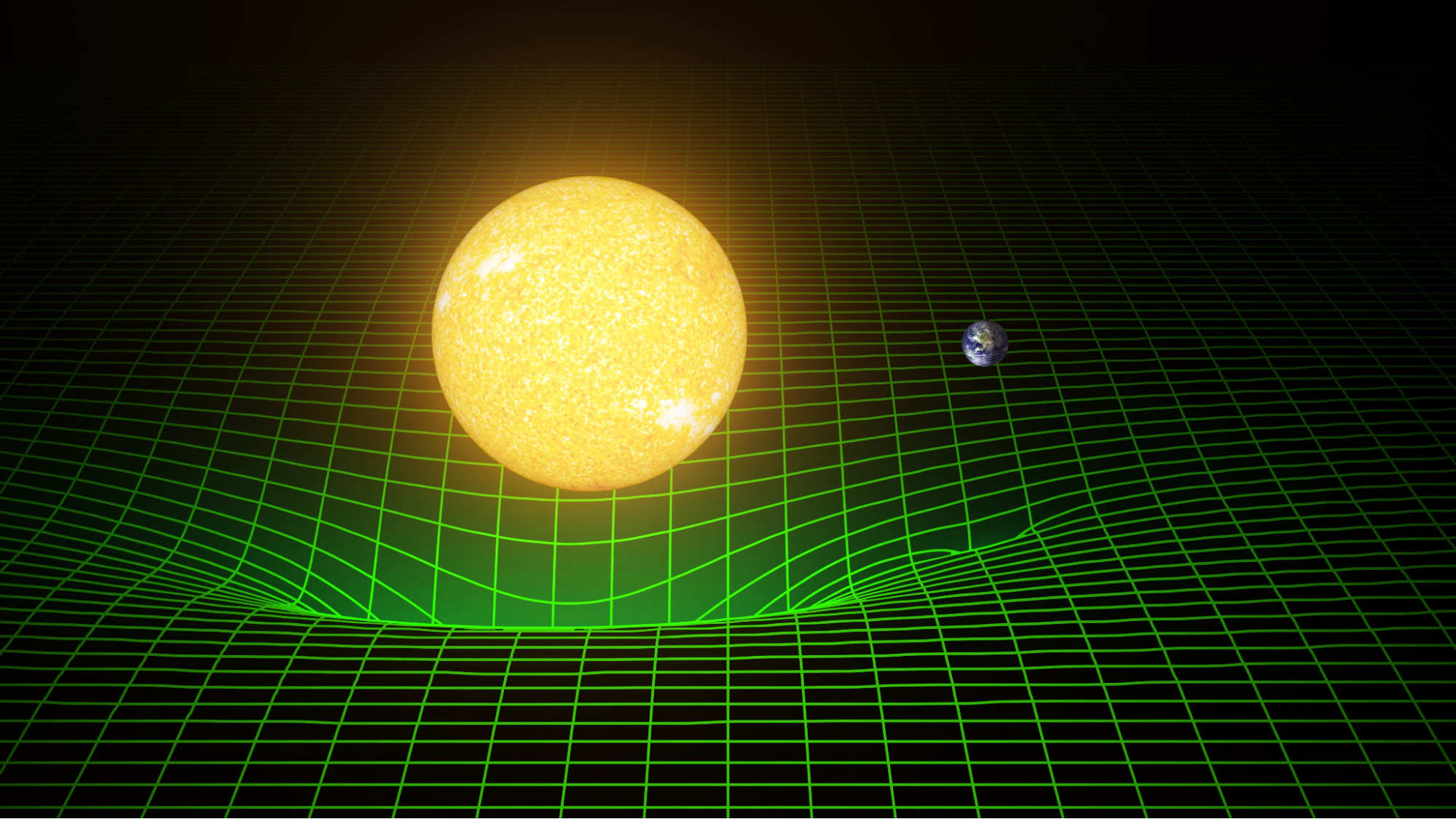
Pyle, T. “Massive Bodies Warp Space-Time,” 11 Feb. 2016, Caltech, ligo.caltech.edu. Accessed 31 May 2026.
For instance, in the image above, the Sun is much more massive than the Earth, causing it to warp the space around it significantly more, which makes Earth and other objects in the solar system move around it along the curved path it creates. Objects tend to move along this curvilinear trajectory of spacetime, with the solar system being an example of how the curvature produced by a massive object can influence the motion of nearby objects. Ultimately, Einstein's theory offered a fundamentally different explanation than Newton's by defining gravity as a property of space and time rather than a force between objects that pulls them together.
The Mystery of Dark Matter
However, there are countless questions even Einstein couldn't answer. Among these mysteries lies an invisible material known as dark matter. Galaxies appear to contain far more gravity than the visible matter inside them can produce, leading scientists to believe that dark matter provides the additional mass. This mysterious substance doesn't interact with the electromagnetic force or ordinary matter, making it completely invisible to telescopes. It does, however, interact with gravity. Therefore, even though it hasn't been detected, its presence is inferred from the movement of stars and galaxies.
In fact, without the powerful gravitational effects associated with dark matter, astrophysicists cannot fully explain the way galaxies retain their structure and rotation patterns. As a result, it is hypothesized that galaxies are surrounded by a halo of dark matter that extends for millions of light years, as shown in the image below.
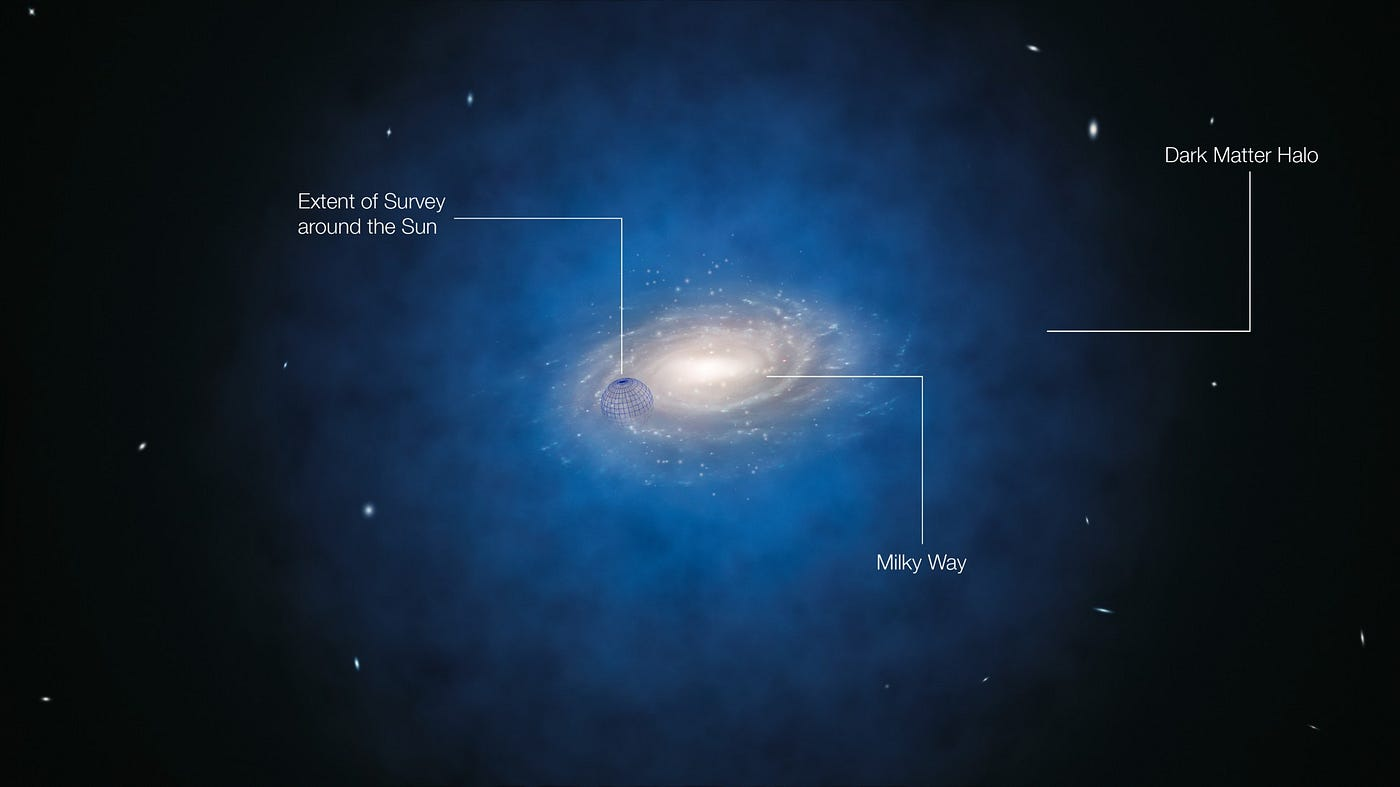
Calcada, L., 14 May 2015, Medium, medium.com. Accessed 10 June 2026.
Not only does dark matter highlight the importance of gravity, but it also illustrates how much there is still left for us to uncover about the universe.
What does this reveal?
Whether it acts within planetary systems or across vast halos of dark matter, gravity is necessary for the universe to maintain its organized structure. Learning about different approaches to gravity — such as Newton's and Einstein's contrasting theories — helps us understand the evolution of scientific knowledge and the different explanations of how gravity shapes the world around us.
Although these theories cannot explain all of gravity's mysteries, their observations and ideas provide a stepping stone towards our understanding of the universe. Despite being nature's weakest fundamental force, gravity's influence stretches across the cosmos, ultimately shaping our entire universe.